
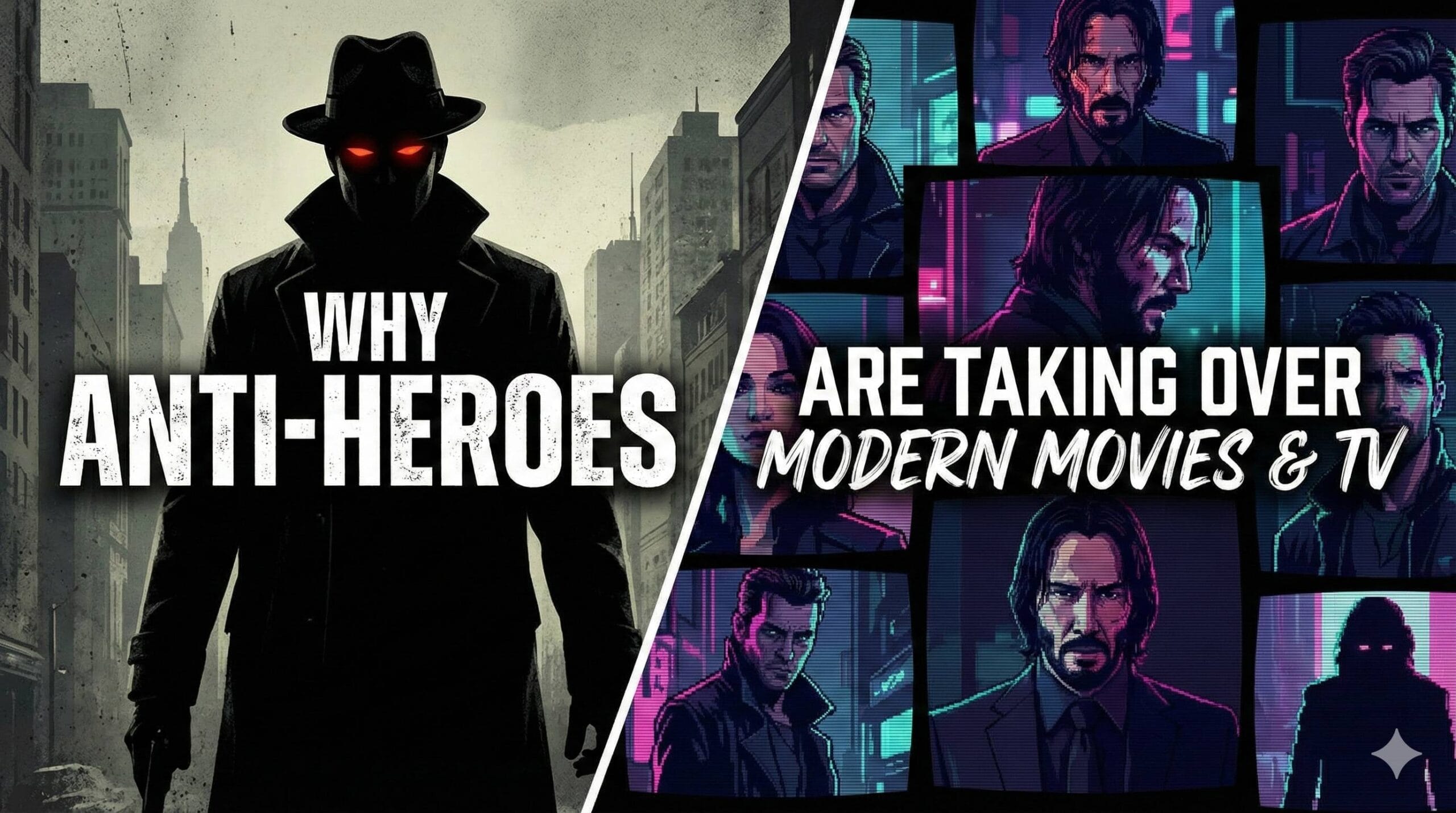
Why Anti-Heroes Are Taking Over Modern Movies & TV
Remember when heroes wore capes and always did the right thing? Yeah, those days are long gone.
Today’s audiences aren’t swooning over perfect Boy Scouts anymore. We’re obsessed with the messy, the flawed, the downright questionable. From Walter White cooking meth in his underwear to Homelander laser-eyeing innocent people while maintaining his PR smile, modern entertainment has crowned a new king: the anti-hero.

But why are we so drawn to characters who break bad, bend morals, and blur the line between hero and villain? Let’s dive into the fascinating psychology behind our collective obsession with the dark side.
The Anti-Hero Revolution: From Side Characters to Main Events
The New Guard of Complicated Protagonists
Gone are the days when Superman’s biggest character flaw was being “too perfect.” Today’s streaming queues are dominated by characters you’d probably avoid at a party:
- Walter White (Breaking Bad): A high school chemistry teacher turned meth kingpin who justifies every terrible decision with “I did it for my family.”
- Loki (MCU): The god of mischief who spent years trying to conquer Earth before we all collectively decided we’d rather watch him be snarky in his own show
- Homelander (The Boys): Imagine Superman if he were raised by a corporation and had the emotional maturity of a toddler with laser eyes
- Harley Quinn: Batman’s villain turned DC’s most beloved chaotic queen
- Deadpool: The merc with a mouth who literally breaks the fourth wall to remind us he’s awful
- Villanelle (Killing Eve): A fashionable assassin who makes murder look disturbingly stylish
- Tony Soprano: The anxiety-ridden mob boss who started the anti-hero trend in the early 2000s
These aren’t your dad’s heroes. They lie, cheat, manipulate, and sometimes straight-up murder people. And we can’t look away.
Why Our Brains Love a Good Bad Guy
The Psychology Behind the Anti-Hero Appeal
Here’s where it gets interesting. Psychologists and entertainment researchers have been scrambling to explain why we’re suddenly rooting for the “bad guys.” Turns out, there are some pretty compelling reasons:
1. They’re Actually Relatable (Unfortunately)
Let’s be real: nobody wakes up feeling like Captain America. But feeling overlooked, underappreciated, or tempted to take shortcuts? That’s everyday life.
Anti-heroes struggle with the same stuff we do, just with higher stakes and better production value. Walter White’s initial motivation wasn’t evil; he wanted to provide for his family after his death. That’s relatable. The meth empire? That’s where things got spicy.
2. Moral Complexity More Interesting Stories
Traditional heroes are predictable. They’ll always save the day, always make the right choice, always refuse to kill. Boring.
Anti-heroes keep us guessing. Will they do the right thing? The wrong thing for the right reasons? The right thing for the wrong reasons? This uncertainty creates narrative tension that traditional heroes simply can’t match.
3. They Permit Us to Be Imperfect
In a world of Instagram filters and curated lives, anti-heroes are refreshingly messy. They make mistakes, harbor grudges, and act petty. Watching them helps us process our own imperfections without judgment.
Psychologists call this “moral disengagement.” We can explore darker impulses safely through fiction without actually acting on them. It’s like therapy, but with more explosions.
4. The “Shadow Self” Effect
Carl Jung would’ve had a field day with modern anti-heroes. He believed everyone has a “shadow self,” the part of our personality we suppress because it doesn’t fit societal expectations.
Anti-heroes externalize these shadows. Loki represents our desire to rebel against authority. Homelander embodies unchecked ego and the corruption of power. Harley Quinn shows what happens when you stop caring what others think (for better or worse).
Watching these characters lets us engage with these aspects of ourselves in a controlled environment.
The Traditional Hero Problem
Why Classic Heroes Feel Outdated
To understand why anti-heroes dominate, we need to talk about why traditional heroes fell out of favor.
The Traditional Hero Checklist:
- Morally pure ✓
- Always selfless ✓
- Never question their mission ✓
- Saves everyone ✓
- Gets the girl ✓
- No real character flaws ✓
Cool in theory. Absolutely exhausting in practice.
The Relatability Gap
Gen Z and Millennials grew up during economic recessions, climate anxiety, political polarization, and a pandemic. The idea that good guys always win and that doing the right thing always pays off? That doesn’t match lived experience.
Traditional heroes feel like propaganda from a simpler time. Anti-heroes feel like Tuesday.
The Authenticity Factor
Today’s audiences value authenticity over perfection. We’d rather watch someone struggle with moral decisions than breeze through them with plot armor. It’s the difference between watching someone play a video game with all the cheat codes versus watching them actually struggle through Dark Souls.
One is technically impressive. The other is emotionally engaging.
How Anti-Heroes Are Changing Storytelling Forever
The Ripple Effect Across Entertainment
The anti-hero takeover isn’t just changing individual characters; it’s revolutionizing how stories are told:
Moral Ambiguity Is the New Normal
Modern shows don’t have clear “good guys” and “bad guys” anymore. The Boys shows us that superheroes can be corporate sellouts. Succession proves that every wealthy family member is terrible in their own unique way. Squid Game demonstrates how desperation turns regular people into monsters.
Audiences now expect nuance. Flat villains who are “evil for evil’s sake” feel outdated.
Villain Backstories Are Mandatory
Thanks to anti-hero popularity, every villain now gets a sympathetic origin story. Joker, Cruella, Maleficent, Hollywood is speedrunning through Disney villains faster than you can say “childhood trauma.”
We’re not satisfied with simple antagonists anymore. We want to understand why they’re terrible.
The Rise of Ensemble Casts of Morally Grey Characters
Instead of one protagonist, shows now feature entire casts of flawed characters. Game of Thrones, Yellowstone, Ozark, everyone’s awful, and we’re glued to the screen watching them out-awful each other.
Endings Don’t Always Mean Redemption
Anti-hero stories don’t always end with redemption arcs. Sometimes characters just… stay bad. Or get worse. Or die unredeemed. And that’s okay because it feels honest.
Walter White didn’t get a last-minute redemption. He got consequences. And audiences respected that.
The Future: What Comes After Anti-Heroes?
Where Storytelling Goes Next
So if anti-heroes have dominated the 2010s and 2020s, what’s next?
Some trends to watch:
- The Anti-Anti-Hero: Characters who’ve been through the anti-hero journey and come out the other side. Think of how The Mandalorian takes a morally grey bounty hunter and slowly softens him through fatherhood.
- Community Over Individual: Shows like Ted Lasso and Abbott Elementary suggest audiences might be craving wholesome content again, but with the complexity we’ve come to expect. These shows feature flawed characters who genuinely try to be better.
- Villain Protagonists: We’re past anti-heroes. Some shows are just making the villain the main character and letting them be terrible. Audiences seem… into it?
- Moral Complexity Without Darkness: The next evolution might be characters who face complex moral situations without descending into darkness. Complicated but not cynical.
What This Means for You (Yes, You)
The Cultural Impact Beyond the Screen
The anti-hero takeover reflects something bigger than entertainment trends:
We’re done with performative perfection. Whether it’s Instagram activism or corporate virtue signaling, audiences can smell fakeness from miles away. We respect flawed authenticity over polished pretense.
We’re comfortable with complexity. Gen Z and Millennials don’t need neat moral categories. We understand people can be simultaneously good and bad, right and wrong, hero and villain.
We want accountability over redemption. Modern audiences would rather see characters face real consequences than get unearned happy endings.
The anti-hero era taught us that messy, complicated, and flawed can still be heroic, just in different ways.
The Bottom Line
Anti-heroes aren’t taking over entertainment because we’ve become more cynical or nihilistic. They’re dominating because they reflect the world we actually live in, complex, morally ambiguous, and refusing to fit into neat categories.
We love Loki because he’s funny and broken. We’re fascinated by Homelander because he’s what happens when power meets insecurity. We couldn’t stop watching Walter White because his descent felt terrifyingly human.
These characters don’t give us easy answers or comfortable morals. They give us mirrors, sometimes flattering, often uncomfortable, always fascinating.
So the next time someone asks why you’re binge-watching a show about terrible people doing terrible things, you can tell them: you’re not watching terrible people. You’re watching complicated people. And in 2025, that’s the most heroic thing of all.
Now, if you’ll excuse me, I have a Villanelle compilation to watch. For research purposes, obviously.